
“The hardest disappointment is in feeling that I’ve failed to do justice to my characters.”
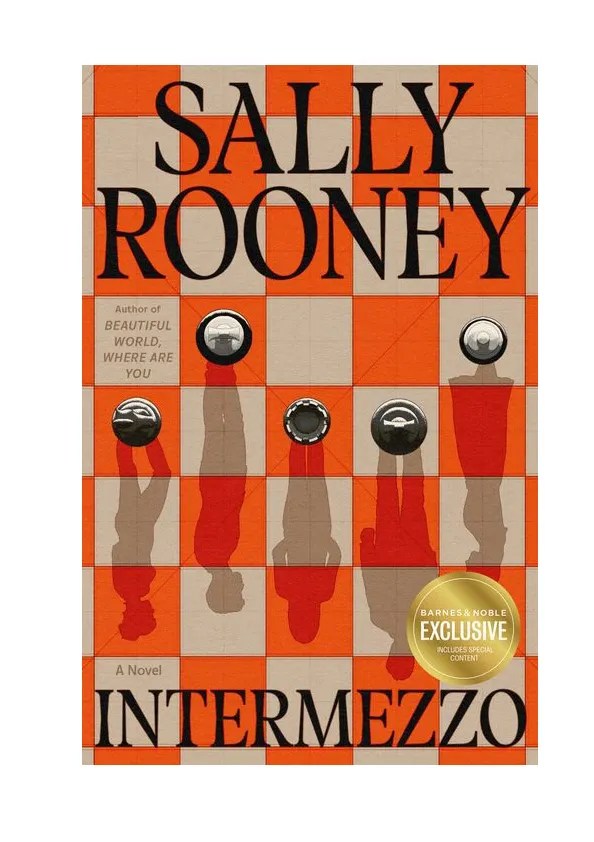
Intermezzo by Sally Rooney
Reviewed by Jenny McPhee
Reading this novel,” Sally Rooney wrote in her introduction to Natalia Ginzburg’s All Our Yesterdays, “we get to know its characters as if they were our own friends, or even ourselves. Many of them are trying hard in various ways to figure out what is right and resist what is wrong … These are not people born with special moral qualities,” she goes on, “people who find it easy to be brave and honorable. We know them: we know quite well that they are just as irritable and selfish and lazy as we are.”
I share Rooney’s love of Ginzburg, and it was this shared love that led me to Rooney’s novels, which I had erroneously believed were for zoomers, not boomers like me. In reading her, I soon found that what Rooney observes about Ginzburg, one of the 20th century’s greatest writers, might easily be said of Rooney’s own work, even if their contexts—Ginzburg’s wartime and postwar Italy; Rooney’s post-capitalist, post-feminist Ireland—seem eons apart.
Rooney, like Ginzburg, has a penchant for meticulously delineating those idiosyncratic details that render a fictional character simultaneously individual and relatable to all. Both writers have an abiding interest in exploring the nooks and crannies of the female experience while also pushing, cajoling, and manipulating the novel form to see just what it is capable of. Both are extremely ambitious and extremely humble.
“When I write something I usually think it is very important and that I am a very fine writer. I think this happens to everyone,” writes Ginzburg in her seminal essay “My Vocation.” “But there is one corner of my mind in which I know very well what I am, which is a small, a very small writer.” This quote is the epigraph to Rooney’s third novel, Beautiful World, Where Are You?
Sally Rooney’s fourth novel, Intermezzo, is predominantly narrated from the points of view of two brothers, Peter and Ivan. Their father has just died, and each brother is navigating his grief. A great part of this entails trying to figure out what kind of man he is going to be in an era in which masculinity remains rigidly defined while, at the same time, up for grabs. As will happen between brothers, each feels existentially threatened by the precarious situation he finds himself in, perceiving the other as his opponent in the game of life. In chess terms, they find themselves facing an “intermezzo,” a sudden attack on everything they thought they knew about the world and their place in it.
 Jenny McPhee