Purchase On:
New York Review Books
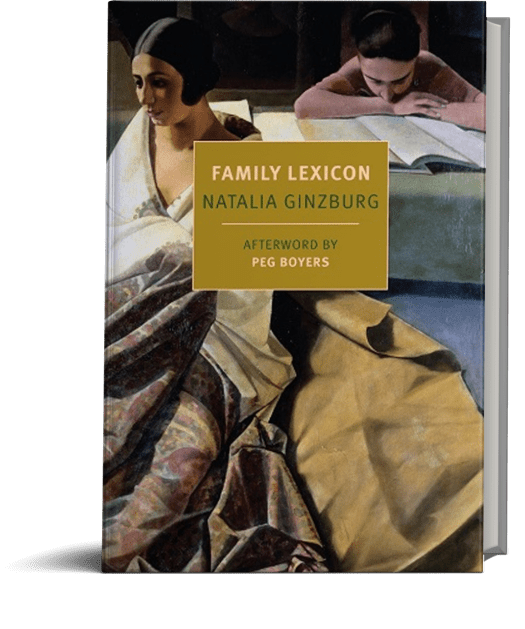
An Italian family, sizable, with its routines and rituals, crazes, pet phrases, and stories, doubtful, comical, indispensable, comes to life in the pages of Natalia Ginzburg’s Family Lexicon. Giuseppe Levi, the father, is a scientist, consumed by his work and a mania for hiking—when he isn’t provoked into angry remonstration by someone misspeaking or misbehaving or wearing the wrong thing. Giuseppe is Jewish, married to Lidia, a Catholic, though neither is religious; they live in the industrial city of Turin where, as the years pass, their children find ways of their own to medicine, marriage, literature, politics. It is all very ordinary, except that the background to the story is Mussolini’s Italy in its steady downward descent to race law and world war. The Levis are, among other things, unshakeable anti-fascists. That will complicate their lives.
Family Lexicon is about a family and language—and about storytelling not only as a form of survival but also as an instrument of deception and domination. The book takes the shape of a novel, yet everything is true. “Every time that I have found myself inventing something in accordance with my old habits as a novelist, I have felt impelled at once to destroy [it],” Ginzburg tells us at the start. “The places, events, and people are all real.”
PRAISE
“While this isn’t the first translation of Family Lexicon, the fact that it’s been given such an outstanding re-translation and that it’s been published by New York Review Books confirms its international importance. That it seems written precisely for our times is more evidence of Family Lexicon’s staying power.”
– Natalia Nebel, Another Chicago Magazine
“Jenny McPhee’s new translation… reads as more contemporary, immediate, and dynamic. Critically, McPhee’s translation emphasizes how language operates within the closed system of a family… In Family Lexicon, familiar words and phrases are the fragments that conjure glimpses of a more complete world, summon what and who has been lost and allow them to continue, to coalesce, condense, collapse. To be carried away, yes, and to carry on.”
– Emily LaBarge, Bookforum
“Ginzburg was a masterful writer, a witty, elegant prose stylist, and a fiercely intelligent thinker…This 1963 novel, newly translated by novelist McPhee, is a genre-defying work. It reads like a memoir, but it doesn’t adhere to the conventions of either fiction or nonfiction….Ginzburg’s ‘lexicon’ is a valuable addition to an already burnished body of work in translation.”
– Kirkus starred review
NOVELS
TRANSLATIONS


 Jenny McPhee